

LISA! Study Abroad
List of Austrian Federal States
All Federal States of Austria with Map and Districts
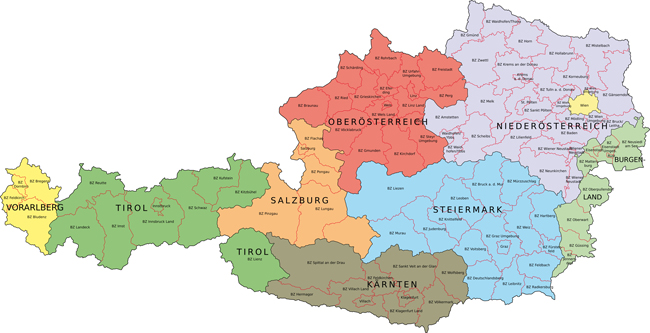
Austria consists of nine federal states, each with its own state government. They are: Burgenland, Carinthia, Lower Austria, Upper Austria, Salzburg, Styria, Tyrol, Vorarlberg and Vienna. The federal states are divided into districts and municipalities. The largest federal state is Lower Austria, covering an area of approximately 19,200 square kilometres.
All Federal States of Austria on the Map with Districts:
 Our travel memories ai-generated
All Federal States of Austria:
List of Austrian Federal States by LISA! Language Travel Austria
| Federal State | Capital | Description |
|---|---|---|
| Burgenland | Eisenstadt | Burgenland is Austria’s easternmost federal state and is known for its mild climate, Lake Neusiedl and wine production. It borders Hungary, Slovakia and Slovenia. |
| Carinthia | Klagenfurt | Carinthia is located in southern Austria and is characterised by numerous lakes, mountains and alpine landscapes. The region is a popular destination for summer and winter sports. |
| Lower Austria | St. Pölten | Austria’s largest federal state surrounds the capital Vienna. It features diverse landscapes including wine-growing regions, Danube wetlands, alpine foothills and historic towns. |
| Upper Austria | Linz | Upper Austria is located in the north and is an economically strong federal state with industrial centres, a rich cultural landscape and the picturesque Salzkammergut region. |
| Salzburg | Salzburg | Salzburg is famous for its baroque old town, Hohensalzburg Fortress and as the birthplace of Mozart. The region is dominated by the Alps and offers a rich cultural heritage. |
| Styria | Graz | Styria is often referred to as the “green heart of Austria”, with extensive forests, wine-growing areas and alpine regions. Graz is a UNESCO World Heritage city with a vibrant cultural scene. |
| Tyrol | Innsbruck | Tyrol is known for its high alpine landscapes, ski resorts and strong mountain traditions. Innsbruck has hosted the Winter Olympic Games several times. |
| Vorarlberg | Bregenz | Vorarlberg is the westernmost and smallest federal state. It borders Germany, Switzerland and Liechtenstein and is known for Lake Constance, modern architecture and the Bregenz Festival. |
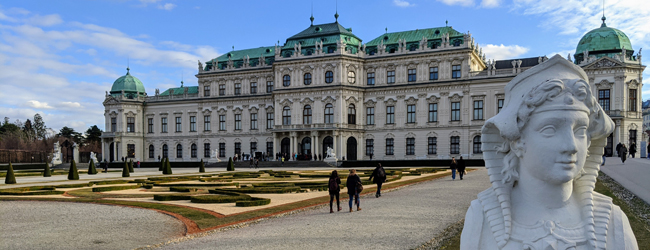
| Vienna | Vienna | Austria’s capital is also a federal state in its own right. Vienna is the cultural, political and economic centre of the country, with a long history, imperial architecture and a vibrant arts scene. |
 Our travel memories ai-generated
Austria by Size:
Austria consists of nine federal states, which differ in both size and economic importance. The largest federal state is Lower Austria, covering approximately 19,200 square kilometres. It surrounds Vienna in a horseshoe shape and borders the federal states of Upper Austria, Styria and Burgenland, as well as the Czech Republic and Slovakia. The smallest federal state is Vienna, with an area of only 415 square kilometres. As Austria’s capital, Vienna is also a federal state in its own right and is completely surrounded by Lower Austria.
The economically strongest federal state in terms of GDP per capita is Vienna, which, as the centre of administration, industry and services, generates the highest economic output. Vorarlberg is also among the wealthiest regions, benefiting from its strong export economy and proximity to Switzerland. The federal state with the lowest GDP per capita is Burgenland, which has the smallest population and is characterised by agriculture and light industry. It borders Hungary to the east and the Austrian states of Lower Austria and Styria.
Styria, the second-largest federal state by area, borders Carinthia, Salzburg, Upper Austria, Lower Austria and Burgenland, as well as Slovenia. Upper Austria, the third-largest federal state, is a major industrial centre and borders Germany, as well as Salzburg, Styria and Lower Austria within Austria. Salzburg is centrally located and is known for its high quality of life. Carinthia, in the south, borders Italy and Slovenia, while Tyrol, which is divided into North and East Tyrol, has three international neighbours: Germany, Italy and Switzerland. Vorarlberg is Austria’s westernmost federal state and borders only Tyrol within Austria, as well as Germany, Switzerland and Liechtenstein.
 Our travel memories ai-generated
List of Austrian Federal States:
-
1. Burgenland
Capital: Eisenstadt
Area: 3,962 km²
Population: approx. 300,000
Highlights: Burgenland is Austria’s easternmost and smallest federal state. It borders Hungary, Slovakia and Slovenia and is known for Lake Neusiedl, wine production and its Pannonian climate.
-
2. Carinthia
Capital: Klagenfurt am Wörthersee
Area: 9,536 km²
Population: approx. 560,000
Highlights: Austria’s southernmost federal state borders Italy and Slovenia. Carinthia is famous for its numerous lakes (e.g. Lake Wörthersee and Lake Ossiach) and alpine landscapes.
-
3. Lower Austria
Capital: St. Pölten
Area: 19,186 km²
Population: approx. 1.7 million
Highlights: Lower Austria is Austria’s largest federal state by area and surrounds the capital city of Vienna. It is known for wine-growing regions such as the Wachau Valley, as well as the Waldviertel and Industrieviertel regions.
-
4. Upper Austria
Capital: Linz
Area: 11,982 km²
Population: approx. 1.5 million
Highlights: Upper Austria is located in northern Austria on the border with Germany and the Czech Republic. Its economy is strongly influenced by industry and mechanical engineering, while Lake Traunsee and Lake Attersee are popular tourist attractions.
-
5. Salzburg
Capital: Salzburg
Area: 7,154 km²
Population: approx. 560,000
Highlights: Salzburg is famous as Mozart’s birthplace and for its baroque old town. The federal state is characterised by alpine scenery and ski resorts such as Zell am See and Saalbach-Hinterglemm.
-
6. Styria
Capital: Graz
Area: 16,401 km²
Population: approx. 1.25 million
Highlights: Styria is often referred to as the “Green Heart of Austria” due to its extensive forests. It is known for the Dachstein mountain range, the thermal spa region and wine production in southern Styria.
-
7. Tyrol
Capital: Innsbruck
Area: 12,648 km²
Population: approx. 760,000
Highlights: Tyrol lies in the Alps and is famous for winter sports destinations such as Kitzbühel, Ischgl and the Zillertal Valley. It borders Germany, Italy and Switzerland.
-
8. Vorarlberg
Capital: Bregenz
Area: 2,601 km²
Population: approx. 400,000
Highlights: Vorarlberg is Austria’s westernmost federal state and borders Germany, Switzerland and Liechtenstein. Lake Constance and the Bregenz Festival are among its best-known attractions.
-
9. Vienna
Capital: Vienna (both a city and a federal state)
Area: 414 km²
Population: approx. 2 million
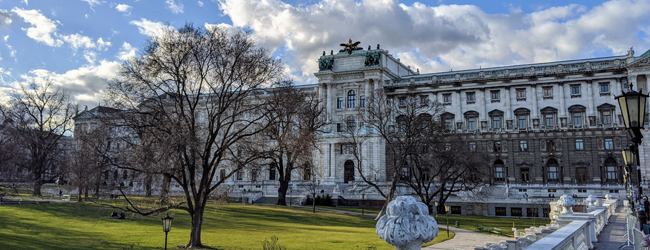
Highlights: Vienna is Austria’s capital and at the same time its smallest federal state. As the cultural and economic centre of the country, it offers numerous attractions such as St. Stephen’s Cathedral, the Hofburg Palace and Schönbrunn Palace. In addition, it is the headquarters of LISA! Language Travel Austria.
English Language Travel Programmes for Students in Malta
Note: In Vienna, we offer German language travel programmes for students. Students from all over the world come to Vienna to learn German as a foreign language. Detailed professional advice is provided by Elke Greim and the LISA! Language Travel team. We would be happy to prepare a personalised offer for you. Please write to us or call us on 0203 - 966-13-09. Our travel memories ai-generated


